
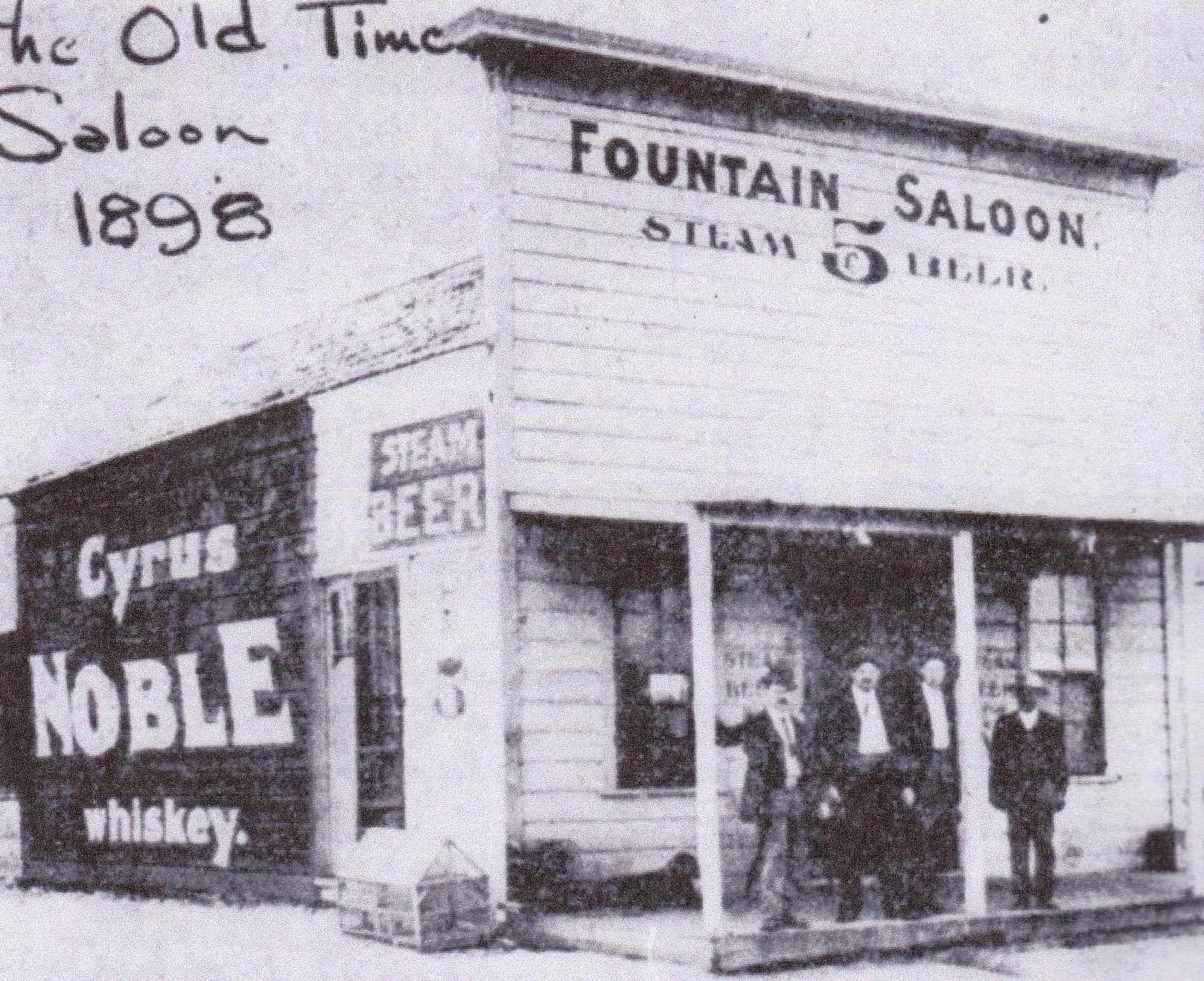
In 1907, Madera with a population of just more than 2,000, had 13 saloons within its city limits. The town’s trustees went on record as opposing such a high saloon/citizen ratio, and expressed a determination to reduce it. In this they were supported by a vocal segment of the population, especially the Women’s Christian Temperance Union.
As the WCTU made plans to build a water fountain in the north-west corner of Yosemite Avenue and D Street (It still stands on that corner, having been erected in 1908), the trustees took a hard look at the saloons and the alleged immorality that they encouraged; any irregularities would cost a proprietor his license and rid the city of what was considered by many to be an undesirable element. It was in this milieu that G.J. Gruber ran into difficulty on Sept. 21, 1907.
Gruber owned a saloon, which stood on the corner of Yosemite Avenue and F Street (present day Gateway Drive). By all accounts, he did a booming business, much to the chagrin of certain political and social forces in the community. Rumors ran wild about his place. Reports of activities that offended decent society were rampant. Sooner or later, given the climate of the times, Gruber was bound to make a mistake. That ax finally fell in the fall of the year.
The man who blew the whistle on Gruber was night watchman D.S. Lewis. As he made his rounds, Lewis observed what he considered to be outrageous violations of public decency. As a man of honor, the night watchman went to the trustees to report on his surveillance. In a special meeting held on Saturday, Sept. 21, 1907, Lewis charged Gruber with permitting women to visit his place of business, selling drinks to intoxicated persons, and “otherwise conducting a disorderly house.” This was a serious affair — one that Madera could not abide. Gruber was called for a hearing before the Board of Trustees.
The prime issue in Gruber’s hearing seemed to be the role of the women who frequented his establishment. Considerable testimony was given regarding whether or not they were simply paying customers. Both Gruber and his barkeeper testified that the two women in question had indeed visited his saloon on Sept. 19, 1907, but that it had only been a social visit and that the ladies had taken only a single drink for which they were not charged. Gruber’s case was weakened considerably, however, when it came time for Nellie and Ruby, the two women, to testify.
Upon examination by the trustees, it was ascertained from the ladies that upon entering the saloon, they were escorted by Henry Hedges to the rear of the building where Gruber kept his living quarters. Ruby remembered that she had ordered the first round of drinks and that the second round came at the request of Nellie. In both cases, the women claimed to have paid for the drinks. The third round was paid for by Gruber himself, with only Hedges escaping the local liquor tariff by not ordering a round of drinks.
As the testimony wound on, it became clear that who paid for the drinks or how many were consumed was not the issue. More to the point was the nature of the women’s visit.
Then, there was also the matter of the serving of intoxicated patrons. A former employee, Barry Kirkland, testified that Gruber had often encouraged him to sell liquor to the town drunks. As far as Kirkland was concerned, Gruber expected him to serve anyone who could reach the bar.
Gruber’s case was doomed, even though he was represented in the hearing by attorney R.E. Rhodes. When Frank Woods, Madera’s other night watchman, was called to testify, he related that he had seen women enter Gruber’s saloon on at least three different occasions over the past several months. Furthermore, he asserted that, indeed, as long as a man could reach the bar and pay for the drink, he was served. Gruber’s heart sank.
After hearing the testimony, the trustees began their deliberation. There is no evidence that they were guided by any ordinance that prohibited women from entering a bar to purchase intoxicating libations. The crux of the case against Gruber, as it related to the women, seemed to be that they might have been there for reasons other than refreshments. This was the position taken by the board.
As far as serving intoxicated patrons, all of the testimony was damaging to Gruber’s case. It was plain that money got one precisely what one wanted in his saloon. Therefore, the Board unanimously voted to revoke his license, and Gruber went out of business overnight.
The elimination of Gruber’s saloon was not the end of the crusade in Madera to bring the legal liquor traffic and its related activities under control. Local anti-liquor sentiment continued to swell, and the city’s Board of Trustees continued to measure each license renewal with a jaundiced eye. They sought to do away with the most objectionable of the establishments.
By 1919, however, the Board could rest easy. The 18th amendment was ratified, and the sale of alcoholic beverages was made unlawful throughout the country. It was no longer a local issue. Now the forces for total abstinence had the power of federal law enforcement on their side.
These national forces, however, were no more successful at enforcing morality than were Madera’s local leaders. Saloons like Gruber’s may have bitten the proverbial dust, but the booze continued to flow, and the world’s oldest profession continued to survive.
It would take more than legislation to create decency. Madera would always have a Gruber’s, it seemed.